
 English
 हिंदी
हिंदी
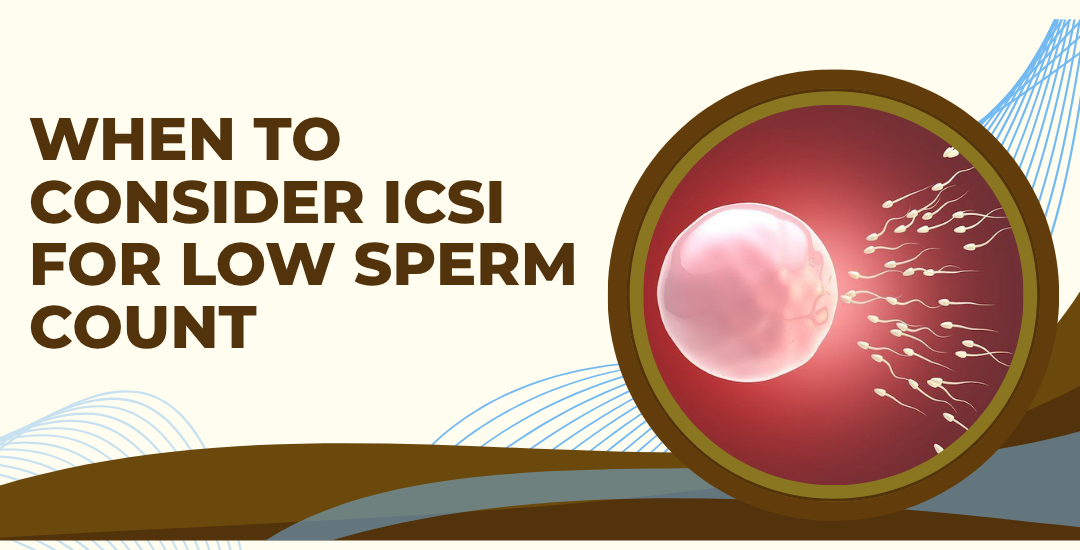
Intracytoplasmic Sperm Injection (ICSI) should be considered when a semen analysis confirms severe male factor infertility, such as very low sperm count, poor motility, or abnormal morphology, making natural conception or standard IVF unlikely. It’s also essential when sperm has to be surgically retrieved through TESA or PESA. ICSI is typically recommended after unsuccessful IUI cycles, or when a previous IVF attempt resulted in poor fertilisation. A single selected sperm is injected directly into the egg, removing the need for natural penetration or competition.
According to Dr. Pratibha Mittal, IVF doctor in Firozabad, Sperm count alone doesn’t decide the treatment path. We look at motility, morphology, hormonal levels, and the female partner’s profile before recommending ICSI over simpler options.
What does a low sperm count report really mean?
A semen analysis measures several parameters, not just the total count. Each one affects fertility differently.
Count: Below 15 million per millilitre and you’re looking at oligospermia. But the number alone won’t tell you how worried to be.
Motility: Here’s where it gets tricky. Sperm can show up in decent numbers and still barely move, and slow swimmers struggle to get anywhere near the egg.
Morphology: Shape ends up mattering far more than people assume. A misshapen head or tail can stop fertilisation even when the count reads fine.
Repeat testing: And honestly, one bad sample proves nothing. Stress, a recent fever, how long you abstained, even how the sample was collected, all of it shifts the result. So we run it again after a couple of months before calling anything.
Both partners get checked together. Reading the male report on its own rarely gives you the whole answer. Plenty of couples start with ICSI treatment in Firozabad once that full workup is done.
When is ICSI the right step for low sperm count?
ICSI isn’t the first-line treatment for every case. It becomes the recommended option once specific clinical thresholds are met. The table below outlines where each approach typically fits.
|
Sperm Profile |
Recommended Approach |
Why |
|
Mild oligospermia (10-15 million/ml), good motility |
Lifestyle, medication, or IUI |
Natural fertilisation still possible |
|
Moderate oligospermia (5-10 million/ml) |
IUI or IVF treatment |
Sperm can still reach the egg with support |
|
Severe oligospermia (under 5 million/ml) |
ICSI |
Too few sperm for conventional fertilisation |
|
Azoospermia (zero sperm in ejaculate) |
TESA/PESA with ICSI |
Sperm retrieved surgically |
|
Poor motility or morphology with normal count |
ICSI |
Sperm cannot penetrate the egg unaided |
Some situations move things along faster than others.
Failed IUI: Two or three rounds that go nowhere usually change the plan, and that’s doubly true when the male factor is sitting right there in the report.
Prior IVF failure: A past cycle where fertilisation flopped? ICSI is nearly always what comes next.
Antisperm antibodies: Rare thing, this. The immune system goes after the sperm, and ICSI sidesteps the problem cleanly.
Frozen or surgically retrieved sperm: When you’ve only got a handful of sperm from TESA or PESA, there’s no room to let them compete in a dish.
So it’s hardly ever about one figure on a page. It’s the whole picture, plus how much time the couple actually has to work with.
Curious what the cycle itself looks like and what drives success? Have a look at our guide on IVF success factors.
Wondering if your semen analysis report actually requires ICSI?
Why Choose Dr. Pratibha Mittal?
Dr. Pratibha Mittal trained hard for this work. An MS in Obstetrics and Gynaecology from Maulana Azad Medical College in Delhi, then a Fellowship in Reproductive Medicine at Fortis, Shalimar Bagh, plus MRCOG Part I from the Royal College in the UK. That kind of background isn’t common once you step outside the metros, and it shows in how the tough male infertility cases get handled.
You won’t get shuffled between junior doctors here. Dr. Mittal runs every stage of the cycle herself, from start to finish. The centre has done more assisted reproductive cycles than anywhere else in the region, and the results have held up. No sending you off to another city.
FAQs
Can low sperm count improve without ICSI?
Yes, mild cases often improve with lifestyle changes and medical therapy.
How long should we try before considering ICSI?
After 12 months of trying, or 6 months if the female partner is over 35.
Does ICSI cure low sperm count?
No, it bypasses the issue to achieve fertilisation but doesn’t restore sperm production.
Is ICSI safer than natural conception?
Risks are comparable, with slightly higher rates of certain conditions linked to underlying causes.
MEDICALLY REVIEWED BY
Dr. Pratibha Mittal Gynecologist, Obstetrician & IVF Specialist. Mittal Nursing Home & IVF Centre, Firozabad. Qualifications: MBBS and MS (OBG) from Maulana Azad Medical College, MRCOG Part I (UK), Fellowship in Reproductive Medicine (IFS, Fortis Hospital). Specialises in IVF, ICSI, recurrent pregnancy loss, high-risk pregnancy, and gynaecological laparoscopy.