
 English
 हिंदी
हिंदी
When an embryo does not implant, the question that follows almost immediately is when the period will come. The wait can be harder than the answer, particularly after a treatment cycle when every symptom is being watched closely. In most cases the period arrives within a few days to about two weeks of implantation failing, though the exact timing depends on whether the cycle was natural or supported by medication.
This guide explains what failed implantation means, the timeline for the period that follows, why it sometimes runs late, and the point at which a review is worth booking.
According to Dr. Pratibha Mittal, IVF doctor in Firozabad, “one failed implantation is rarely a reason to worry on its own, because it happens in many healthy cycles. What I pay attention to is a pattern, and that is when a proper evaluation starts to matter.”
What Does Failed Implantation Mean?
Implantation is the stage where a fertilised egg attaches to the lining of the uterus and begins to grow. When this does not happen, or when an embryo attaches briefly and then stops developing, it is called failed or unsuccessful implantation. The pregnancy hormone hCG never rises far enough to sustain a pregnancy, so the lining is shed as a period instead.
This is more common than most people realise, and it occurs in natural conception as often as in treatment cycles such as IUI treatment, frequently before a woman even knows conception took place. A single failure usually reflects an embryo that was not able to continue, rather than anything wrong with the mother.
Has a cycle not worked out the way you hoped? A clear assessment can tell you why.
How Long After Failed Implantation Does Your Period Start?
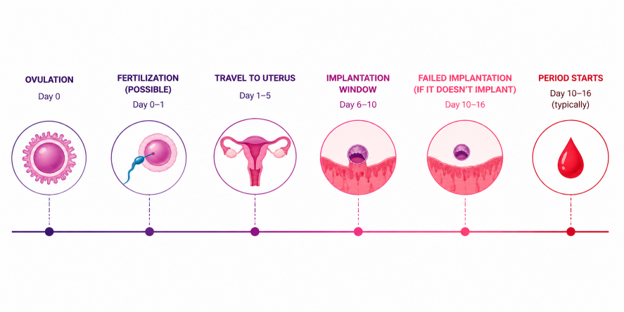
The timing depends largely on whether the cycle involved fertility medication, because hormones change how and when the lining sheds.
In a natural cycle
If conception was attempted naturally, the period usually arrives close to the expected date, give or take a few days. When implantation fails, progesterone falls and the lining begins to shed within roughly one to two weeks of the attempted implantation, which often lines up with the normal cycle.
After an IVF or frozen embryo transfer
Cycles using IVF treatment work differently because progesterone is given as a medicine to support the lining. The lining is held in place for as long as that support continues, so the period does not begin until the progesterone is stopped, usually after a negative blood test. Once it is stopped, bleeding tends to start within two to four days. This is why the period can feel delayed after a treatment cycle even though nothing is wrong.
What the bleeding is like
The first period after a failed cycle is often heavier than usual, sometimes with more cramping, because the medication-supported lining can be thicker. Some clots are normal. The cycle after that generally settles back to its usual pattern.
Why Is My Period Late After a Failed Cycle?
A delayed period after a failed cycle does not always mean something is wrong, but it is worth understanding the common reasons:
- Lingering hormones. Fertility medication takes time to clear, and the body needs a few days to reset before bleeding begins.
- The emotional weight of a failed cycle can itself delay ovulation and the period that follows.
- A late or chemical pregnancy. Occasionally an embryo implants briefly before stopping, which shifts the timing of the bleed.
- An underlying cycle issue. Conditions such as thyroid imbalance or PCOS can make periods irregular regardless of the cycle outcome.
If two weeks pass after stopping progesterone with no period, a gynecology consultation is sensible to confirm the hormone levels have settled and rule out a lingering pregnancy.
What to Do Next After Failed Implantation

The period marks the close of one cycle, not the end of the road. A few steps help turn a disappointing result into useful information:
- Allow the body to recover. One natural cycle of rest before trying again is common practice and gives the lining time to rebuild.
- Note the pattern. Record how long the period took to arrive and how heavy it was, since this helps the doctor read the cycle.
- Ask for a review after repeated failures. A single failed cycle is usually left alone, but two or more in a row is the point to look deeper.
- Investigate the uterus and embryo factors. Repeated failure can point to the lining, the cavity, or embryo quality, all of which can be assessed.
Where the uterine cavity may be the issue, a hysteroscopy can look directly inside for polyps, adhesions, or a septum that might stop an embryo from settling.
Depending on what the review finds, the next plan may involve adjusting the IVF protocol, changing the timing of the transfer, or addressing an underlying condition before trying again.
Have you had more than one cycle fail? It may be time to look at why.
Why Choose Dr. Pratibha Mittal After a Failed Cycle
A failed implantation calls for a calm, methodical look at what happened rather than a rushed change of plan. The care here is built around understanding the cause before recommending the next step:
- Experienced specialist. Pratibha Mittal holds an MS in Obstetrics and Gynecology from Maulana Azad Medical College and a Fellowship in Reproductive Medicine, and manages recurrent implantation failure and pregnancy loss.
- Cause-first approach. Each failed cycle is reviewed for the factors that can be corrected, rather than simply repeating the same protocol.
- Full diagnostic support. The uterine cavity, hormone levels, and embryo factors can all be assessed under one roof.
- Honest guidance. You get a realistic view of what the result means and what genuinely improves the odds next time.
Ready to understand your cycle and plan the next step with confidence?
FAQs
How long after failed implantation does the period start?
Usually within one to two weeks in a natural cycle, or two to four days after stopping progesterone in a treatment cycle.
Is the first period after a failed cycle heavier?
Often yes. It can be heavier with more cramping because the lining was thicker, and it usually settles by the next cycle.
Does a delayed period mean I am pregnant?
Not necessarily. Lingering medication and stress can both delay it, so a blood test is the reliable way to confirm.
When should I see a doctor after failed implantation?
If there is no period two weeks after stopping progesterone, or after two or more failed cycles in a row.
How can I book a consultation with Dr. Pratibha Mittal?
Call +91-9971356403 or +91-9990848807, or fill in the contact form on the website, and the team will arrange your appointment.